
How Do You Know If Your Baby Needs an Infant Head Shape Helmet?
Summary: A baby’s head shape will change quickly during the first months of life, leaving parents unsure about what is normal and what needs attention. This guide explains common signs of plagiocephaly and brachycephaly, factors clinicians consider before recommending treatment, and how evaluation helps determine whether an infant head shape helmet or head shaping helmet may be appropriate for your baby.
Noticing a flat or uneven area on your baby’s head may raise many questions. Parents often wonder whether the shape will improve naturally, whether repositioning is enough, or whether their baby needs an infant head shape helmet. These concerns are understandable because an infant’s skull remains flexible during early development, allowing the brain to grow. This flexibility also means external pressure may influence head shape.
The flattening should be evaluated by a healthcare professional, who can determine if it is positional plagiocephaly, brachycephaly, or something else. Treatment recommendations are based on severity, age of baby, shape changes, repositioning, or other conservative treatment. Helmet therapy is not recommended for all babies; it is still important to have a professional evaluate each child's needs as the first step.
What Does an irregular Baby Head Shape Mean?
Infant skulls are made up of a series of soft bony plates and have flexible sutures. These allow the skull to expand when the brain grows during the baby's early development. A baby that frequently sleeps on their back could set the stage for flattening.
Frequently, this flattening is seen on one side of the back of the head and is termed plagiocephaly. Parents may also notice that one ear appears slightly farther forward or that the forehead looks somewhat different from one side. Brachycephaly is where the back of the head is flattened all over.
Babies are more prone to positional head flattening when they spend considerable time lying down in their early months. Some cases improve as babies gain head control, they are able to move more frequently and have less time remaining in the same position.
Signs Parents May Notice at Home
Changes are often recognized before anyone else by parents. By observing your baby's head from a number of these angles, you may be able to pick out some differences that you should talk to your pediatrician about.
Some signs include:
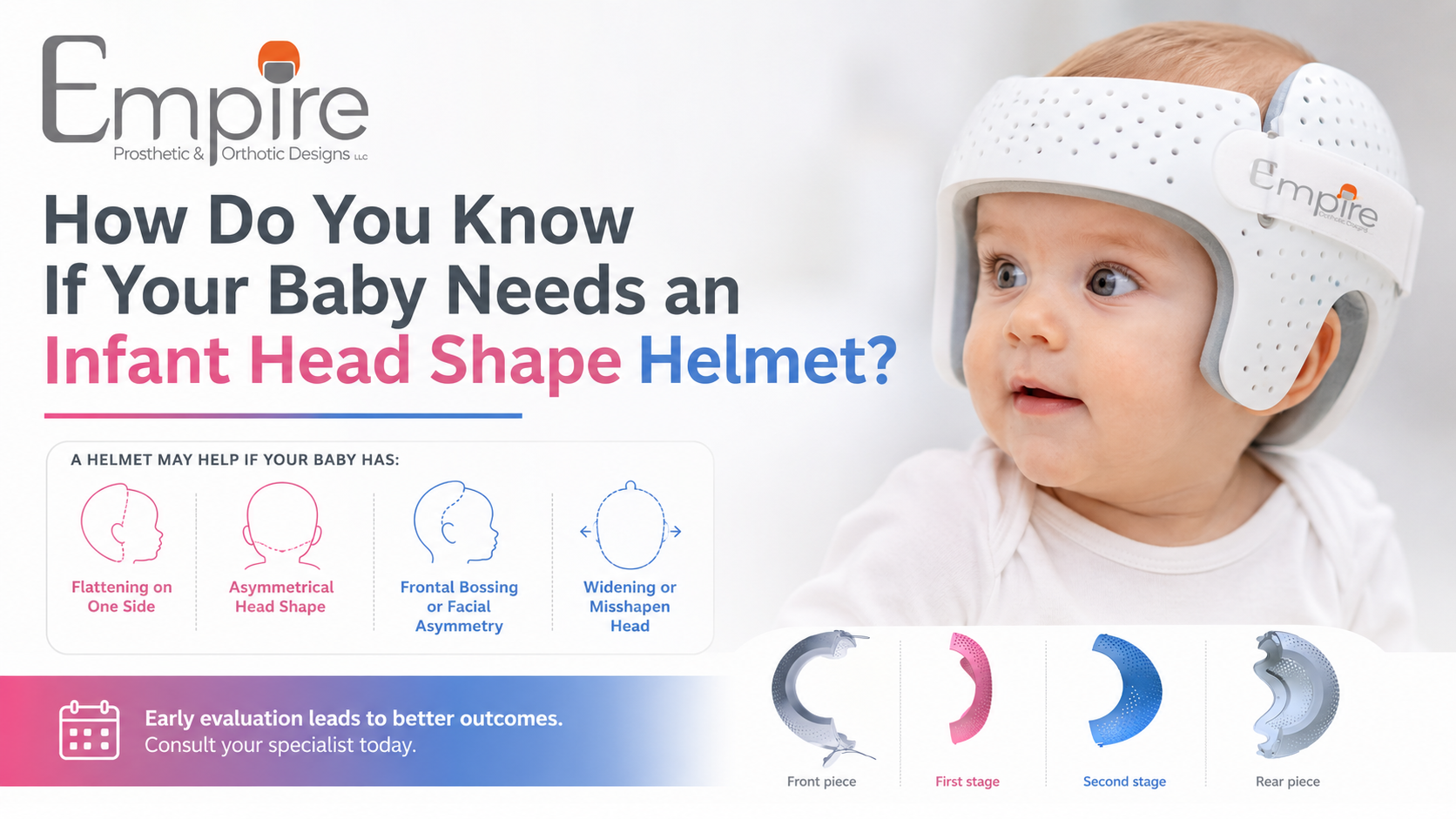
● A noticeably flat area on one side of the back of the head.
● Flattening across a larger portion of the back of the head.
● Uneven positioning of the ears.
● A forehead that appears more prominent on one side.
● A preference for turning the head toward one side.
● Difficulty turning the head equally in both directions.
● Head shape that remains noticeably uneven as your baby grows.
● A wider head when looking from the front.
● A taller or conical appearing head, particularly in the back.
● The face appears small.
The observations are not necessarily a requirement for the baby to receive a helmet treatment. They offer information that is helpful to a healthcare provider who can inspect your baby and make a diagnosis as to the possible cause of the asymmetry.
When a Cranial Remodeling Helmet May Enter the Conversation
A clinician may consider helmet therapy when head flattening remains moderate to severe, does not improve sufficiently with conservative measures, or requires additional correction during a period when the skull remains responsive to remolding.
Age also matters. Johns Hopkins notes that cranial remolding may be prescribed for some infants with deformational plagiocephaly or brachycephaly, particularly during infancy, and emphasizes that not every child is a candidate.
Parents should not just make their decision about helmet therapy because of the child's age. A professional assessment puts into perspective the decision to make an appropriate treatment.
Why Severity Matters?
The degree of asymmetry plays an important role in treatment planning. A small flat spot may improve with growth and positional changes, while more pronounced asymmetry may require additional intervention.
The clinician can examine the baby's head in various positions and evaluate its symmetry, proportions, growth, and movement. Some even employ measurements or three-dimensional scanning technology to better determine its shape.
A custom-made head shaping helmet is designed to create room for growth in places and mould the growing skull to a balanced shape. Proper fitting and follow-up continue to be important due to continued growth of the infant's head during treatment.
What Happens During an Evaluation?
An evaluation will start with talking about your baby's development, positioning behaviors, birth history, and when you first noticed your baby's change in head shape.
The clinician is evaluates:
● Overall head symmetry.
● Flattening at the back or sides.
● Forehead and facial symmetry.
● Ear position.
● Neck movement.
● Head growth.
● The severity and pattern of asymmetry.
This difference is a crucial factor that must never be overlooked, especially when assessing. Parents should not diagnose a head shape problem solely by looking at pictures or at a comparison on the internet between their child's head and that of an average head.
Conclusion
Knowing whether your baby needs cranial remolding starts with understanding the difference between a temporary positional change and persistent head shape asymmetry. Parents may notice flattening, uneven ears, forehead differences, or a preference for turning the head in one direction, yet these signs alone do not determine whether treatment is necessary.
An infant remolding helmet may become part of the treatment plan when a qualified clinician identifies appropriate circumstances, such as persistent or more pronounced positional asymmetry. Evaluation also helps rule out other causes of abnormal head shape and gives parents a clear path forward.
If you have concerns about your baby’s head shape, consider scheduling a professional evaluation rather than relying on assumptions or comparisons with other babies. Empire Helmets is available to help families understand their options and take the next step with greater clarity and confidence.
Frequently Asked Questions
1. How do I know if my baby has plagiocephaly?
A flat area on one side of the back of your baby's head, one ear more pointed than the other, or one side of the forehead being more symmetrical than the other may be noticed. Your baby will have to be assessed as part of the treatment process to see if the changes are due to positional plagiocephaly.
2. Should I wait to see if my baby’s head shape improves?
You do not need to make that decision without professional guidance. If you notice persistent flattening or asymmetry, discussing it with your pediatrician or a qualified cranial remodelling provider may help you understand whether monitoring, repositioning, or further evaluation makes sense.
3. At what age might helmet therapy be considered?
The timing will vary with the response of your baby and his or her head shape, age, growth, and the other therapies used. Helmet therapy is given in infancy for moderate or severe asymmetry.
4. Does a cranial remolding helmet hurt?
A properly fitted helmet is designed to guide skull growth rather than squeeze the head. Babies need to be observed while receiving therapy to allow clinicians to resolve fit problems, skin concerns or other issues right away.
